One poet whose work shares some similarities with Garside’s is Sylvia Plath. Both Garside and Plath delve into the depths of human emotions, exploring themes of love, loss, and existential struggles. Like Plath, Garside’s poetry is often introspective, offering profound insights into the complexities of the human experience. However, Garside brings his own distinct voice to his work, infusing it with a lyrical quality that sets him apart.
Another poet worth comparing to Garside is Robert Frost. Both poets have a keen eye for nature and employ vivid imagery to create powerful evocations of the natural world. Garside, like Frost, often uses nature as a metaphor for deeper human emotions and experiences. However, while Frost’s poetry tends to be more straightforward and accessible, Garside’s work often embodies a more enigmatic and introspective quality.
In comparing Damian Garside’s poetry to that of these renowned poets, it becomes clear that he has carved out his own unique space within the literary landscape. His ability to navigate the complexities of human emotions while incorporating captivating imagery sets him apart as a truly exceptional poet. By delving into the works of Garside alongside those of Plath, Frost, and others, readers can gain a richer appreciation for the depth and brilliance of his poetic voice.
Ah, yes, social Darwinism be your inclination pitbull terriers — they are your thing;
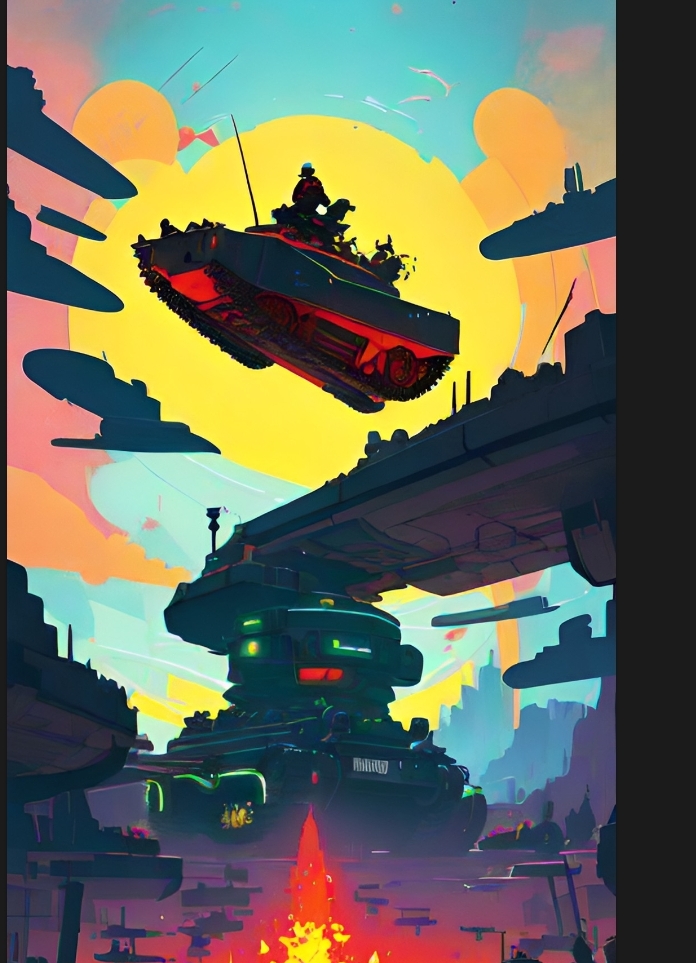
but would you pit, against a tank, this, or some other poem
without ceramic armour, without armour-piercing depleted uranium shell?
For all poem got going for it is knowledge of shadow, and pulse of humanity
and that is sure-fire defeat, on hiding to nothing, as a Nobel Laureate does suggest himself suggest
Oh, if only tanks could be stopped in their tracks by bloke with shopping bang
barrels get so stuffed with gorgeous flowers things might misfire; shells and bullets simply melt
in the face of all that sweetness and light (and metaphor, let us not forget) the antennae of the species wrote on paper, in clay, on the digital universe
who dare order? what dare fire?
but then, who has ever really talked to the mind of a tank?
I am done with dissonance except where it captures the complexion of what surrounds gives taste of the chaos that riddles through
harmony is the thing that must nourish, bring together harmony that feels like impossible belief
when last, if ever, were woken by wings hovering above taking angelic form?
just add a few Pratt and Whitneys and there you have dissonance
what you figured might be Michael, Uriel, Gabriel drowning out the room with clamour of regular comic superhero (or, indeed villain) elevated to cosmic, epic, mythical proportions by virtue of three- act structure, and titanic movie screen
already you can see it touch it smell it feel it, let alone hear it
this dissonance, every tiny breath of harmony here in me, here in the poem
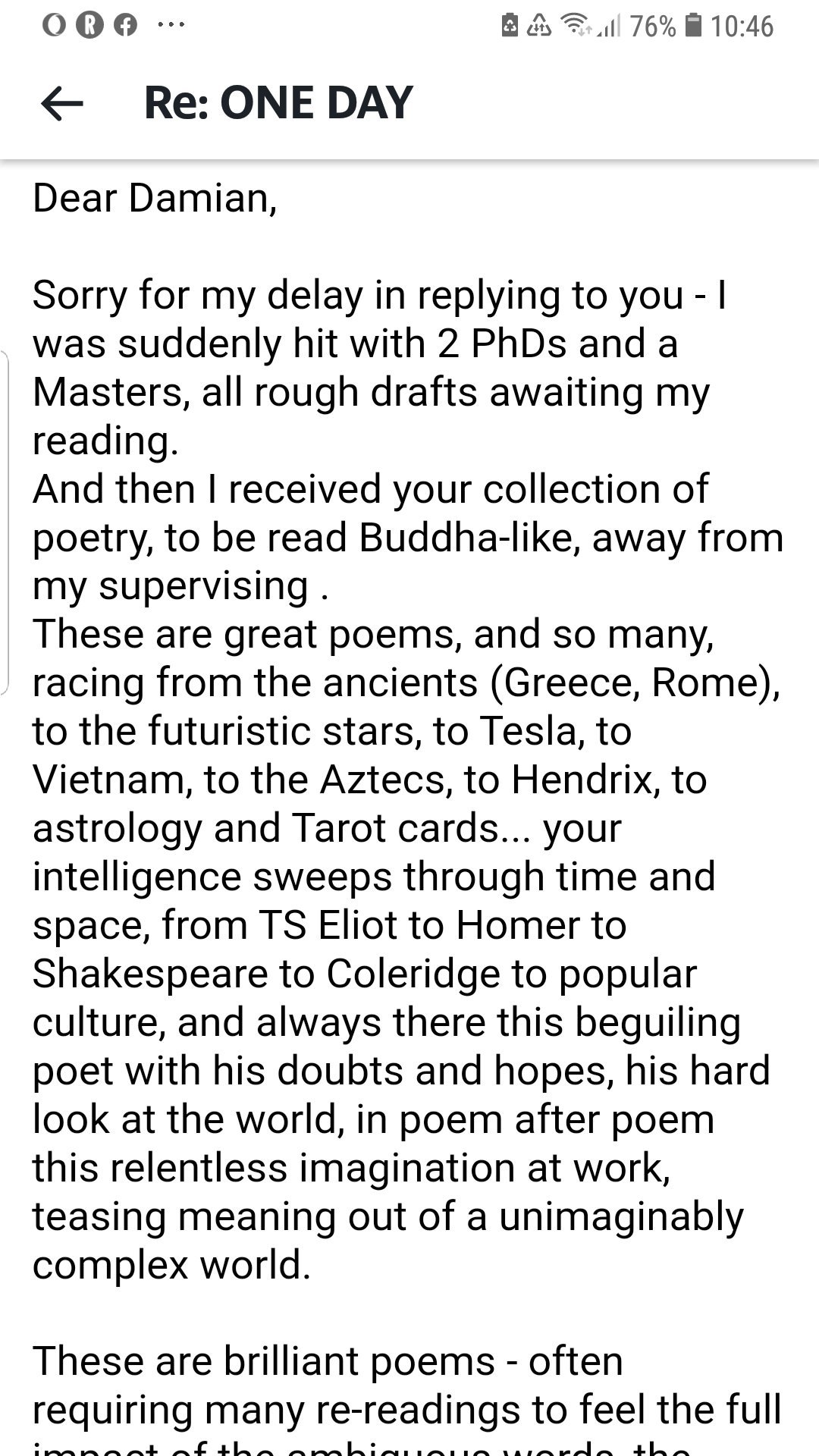
Sorry for my delay in replying to you – I was suddenly hit with 2 PhDs and a Masters, all rough drafts awaiting my reading.
And then I received your collection of poetry, to be read Buddha-like, away from my supervising .
These are great poems, and so many, racing from the ancients (Greece, Rome), to the futuristic stars, to Tesla, to Vietnam, to the Aztecs, to Hendrix, to astrology and Tarot cards… your intelligence sweeps through time and space, from TS Eliot to Homer to Shakespeare to Coleridge to popular culture, and always there this beguiling poet with his doubts and hopes, his hard look at the world, in poem after poem this relentless imagination at work, teasing meaning out of a unimaginably complex world.
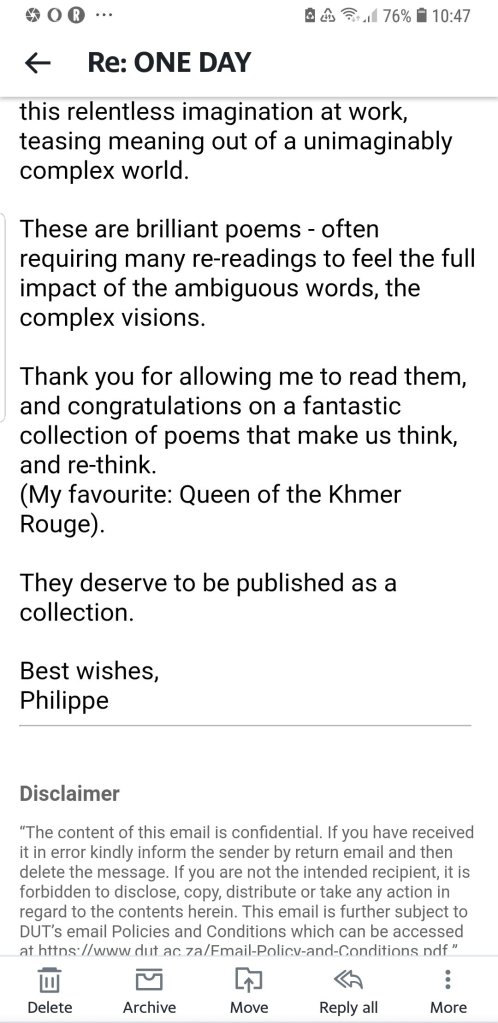
These are brilliant poems – often requiring many re-readings to feel the full impact of the ambiguous words, the complex visions.
Thank you for allowing me to read them, and congratulations on a fantastic collection of poems that make us think, and re-think.
(My favourite: Queen of the Khmer Rouge).
They deserve to be published as a collection.
Best wishes,
Philippe
Disclaimer “The content of this email is confidential. If you have received it in error kindly inform the sender by return email and then delete the message. If you are not the intended recipient, it is forbidden to disclose, copy, distribute or take any action in regard to the contents herein. This email is further subject to DUT’s email Policies and Conditions which can be accessed at https://www.dut.ac.za/Email-Policy-and-Conditions.pdf ” .
what am I saying? a mysterious collection of texts appears housed quite compactly in a mysterious bookcase (in fact the fit between books and bookcase is, uncertainty theorem aside, mathematically exact)
my fall from grace was reading these books, taking from this tree
though the fruit was gorgeous waking up from violently lucid dreams and vomiting over the bedspread I figured there might be some value in the sacred prohibitions against the blasphemy of writing reading
but who wrote these books and who wrote the words leaking through the brickwork suddenly manifesting themselves on the walls?
I write down my dream but then read further, find, it was already written suddenly the term “intertextual” is no longer just radical polyphony of meaning but being stretched and pulled apart by the conflicting gravitational pull of dramatically dissonant worlds
I burn all I have written the storehouse of my life stacked in a pyre having failed the inquisition
we are all locked in a fiction, a forever thread-creating, fabric splicing brain