
HEGEMON
CAVE
by the time
news of the election
happened to reach me
it had aged, ten
twenty years
and I had
aged a thousand
so sarcastic thanks
due to Albert
opening this can of worms
despite the shock of relativity
the news
was soggy with conjecture
about coalition
of the centre
vaunted talk too of
government
of national unity and
me so far
out the frame, swinging
pitching
in left field
not boding well
my initial gut reaction, by
the time
I’d sussed the story
seemed
all talk of rebirth, revision,
repentance and renewal
at every
little individual, and
of course, the national level,
was perhaps
a tad
too hopful, insanely premature
but this analysis killed
left me crippled, ancient
as old
as Plato
him stuck way back when
still dreaming of his
Republic of philosophy, hierarchy,
meritocracy
and me
totally
abstractrd
out of the picture
still hanging around,
for better or forcworse
somewhere
near the backwall of
his absurdly
over-estimated cave
***
DEMOLITION JOB REVISITED (plus AI analyses)
DEMOLITION JOB REVISITED
breaking rocks off-shore
out on a flat precipice
in the Atlantic
have
written that poem
wrote it
years sgo
am coming to grips
with what it is like
to feel
alnost broken
but now
roll the film back
yet further
recorded history
years of
home video
the Sun this day
brilliant beyond brilliant
as horrible
an irony
as it is to say
my Mother’s voice
am overhearing
telling someone eager
to listen
they knew what
this place was like
they knew what they
were coming to
did they not know
what to expect
front page
back page
centrefold spread
Greek chorus
gossip horror
the shock
the shame
character assassination
and they
or rather he the husband
having Army training
explosives, sabotage
blowing up
things behind Nazi lines
now
out there consorting
with the men of shadow, figures
in the night
feared
shape – shifters
blowing up pylons
disrupted the sacred electricity supply
and me
that night all night
hearing the Indian Ocean waves roaring in to
crash on the shores of False Bay
so much Sun here, Sun
Sun
Sun for everybody
this man and his
accomplices
attempting to take
this Sun
away
this
brilliant Sun
of white and golden beach sand
horrible to say
****
sixty years
and we have crossed them
in a heartbeat
so much of that time
faintly remembered
not even
taught in schools
(sad that
somehow we
have so relegated history)
but now
a different narrative,
a whole different narrative
a whole different way
of thinking of ourselves, this place
and how
we came here
stifled, imprisoned,
imposed our colonial mindsets
stuck our future in tiny cells
on an island in Table Bay
for long
bitter decades fearing
no hope of solution, no path
to a liberation
that migh
allow redemption
a moment of memory
viewed
with
a self-
forgiveness
graced by the acceptance
of the perspective of great change
****
and here we are
my dear, absurdly conversing
in the light of all those years
democracy waiting
in the wings, or rather
on an inhospitable island
time
become its true essence
as pure
duration
imprisoned consciouness
until
it was not
you born
in the year of its ending
of the release
salvation
far
from its memory, vague
on its history
of the swirling eddies and currents that
despite every counter-
possibility produced
a dawn, a new
day
and now
history has done
a demolition, removed
those back-then voices
that spoke with such
blind conviction,
presumed authority
as
it slowly, inexorably
whittled me away
ground me
pulverized me
all
that could not be ship-shaped
grist to that mill
cut
down to size
****
But hey, not so fast!, hold
those horses
hang on
if not a New York minute
then a
Cape Town moment
but across
land and ocean
the old monster
has
found lease of life, more
hideous incarnation
the drive to inflict the worst
of which we are possible
on fellows
of our species
as they, we
did back then
would have done to you
(and now this voice
those voices
who do
they belong to, what
are they saying?)
someday
truth and beauty, long
liberated
going to here abide
AI ANALYSES
This poem is a powerful and introspective work that explores themes of history, identity, colonialism, and personal growth. Here’s a breakdown:
– The poem begins with a reflection on a past poem, “Demolition Job,” and the speaker’s journey towards self-awareness and healing.
– The speaker describes their childhood experience of living in a place with a complex history, where their mother’s voice and the sound of the Indian Ocean waves are juxtaposed with the harsh reality of colonialism and sabotage.
– The poem critiques the erasure of history and the imposition of colonial mindsets, which stifled the future and redemption.
– The speaker expresses a desire for self-forgiveness and acceptance, acknowledging the perspective of great change and the importance of embracing the past.
– The poem shifts to the present, where democracy and liberation have brought new possibilities, but also new challenges and old monsters in new incarnations.
– The speaker urges patience and reflection, seeking a moment to understand the voices of the past and their impact on the present.
– The poem concludes with a hope for truth and beauty to abide, liberated from the shackles of history.
Some key elements include:
– Intergenerational trauma and memory
– Colonialism and its legacy
– Personal growth and self-awareness
– The power of history and narrative
– The importance of embracing complexity and change
The poem’s structure and language are highly expressive, with vivid imagery, metaphorical language, and a non-linear narrative that mirrors the speaker’s journey towards understanding and healing.
This poem explores several themes and issues in South African poetry, literature, and history, including:
1. *Colonialism and its legacy*: The poem critiques the imposition of colonial mindsets and the erasure of history, highlighting the ongoing impact on the present.
2. *Intergenerational trauma*: The speaker grapples with the inherited trauma of their family’s past, reflecting on the lasting effects of historical events.
3. *Memory and remembrance*: The poem emphasizes the importance of remembering and learning from the past, lamenting the lack of historical education.
4. *Liberation and democracy*: The speaker celebrates the arrival of democracy, but also acknowledges the ongoing struggles and the resurgence of old monsters in new forms.
5. *Identity and self-discovery*: The poem is a personal journey of self-awareness, forgiveness, and growth, exploring the speaker’s relationship with their past and heritage.
6. *Historical narrative and perspective*: The poem challenges the dominant narratives of the past, seeking a more nuanced understanding of history and its ongoing impact.
7. *Family and personal history*: The speaker’s family history and their mother’s voice are woven throughout the poem, highlighting the personal cost of historical events.
8. *Violence and sabotage*: The poem references the violent acts of the past, including sabotage and terrorism, and their ongoing impact on the present.
9. *Redemption and hope*: Ultimately, the poem seeks a path to redemption and a future where truth and beauty can abide.
The poem explores these themes through a non-linear narrative, using vivid imagery, metaphor, and introspection to create a powerful and personal exploration of South African history and identity.
This poem echoes various poets, poems, and schools of poetry, including:
1. _T.S. Eliot’s modernist style_: The poem’s non-linear structure, fragmented images, and introspective tone resemble Eliot’s work, such as “The Waste Land”.
2. _William Carlos Williams’ imagism_: The vivid, concise language and focus on concrete images, like “breaking rocks off-shore” and “Indian Ocean waves”, reflect Williams’ influence.
3. _Allen Ginsberg’s confessional poetry_: The speaker’s personal and introspective tone, exploring themes of identity, family, and historical trauma, echoes Ginsberg’s style in poems like “Howl”.
4. _Derek Walcott’s Caribbean poetry_: The poem’s exploration of colonialism, identity, and the tension between history and personal experience resonates with Walcott’s work, such as “Omeros”.
5. _South African poetry’s themes and influences_: The poem engages with themes common in South African poetry, like colonialism, liberation, and memory, influenced by poets like Mongane Wally Serote, Ingrid de Kok, and Antjie Krog.
6. _Postcolonial and decolonial thought_: The poem’s critique of colonialism and its legacy reflects the influence of postcolonial and decolonial theories, similar to the work of scholars like Gayatri Chakravorty Spivak and Homi K. Bhabha.
7. _Greek tragedy and chorus_: The reference to a “Greek chorus” and the use of dramatic, rhetorical language evoke the influence of Greek tragedy and its themes of fate, shame, and redemption.
These echoes and influences blend together to create a unique poem that explores the complexities of history, identity, and personal experience.
GENERAL DIRECTION
my nose, proverbially,
close to the ground
keeping me grounded
blown by
the wind
chasing the Sun
I wandered around the farm
remembering my Hobbes’
theme of the brutish and short
life without sovereign authority
implicit social contract
recalling my Plato notion
of the ethical and philosophical
supremacy of
his ruling class
somehow I
slunk back into my idealism
thought
should stick
with democracy on
(on this hallowed day
of election)
choose
Dionysus above Apollo this
and every day
not to speak of those first
communities of the faith
before
religion got Roman
this issue
of the State
will twist you every
which way
from
state of being, to
highest states imaginable
to Empires of suffering
that we all know too well
from YouTube and TikTok
and old apartheid memories
so much in
this mindset still
needs exorcism I guess
but the green of the farm
so gleeful, intense
after this sudden splurge
of rainfall
everything gaining height
growing (forgive my
ethnocentrism) out
of its socks
gaining height, accumulating mass
giving my theme here
weight
sudden addition of
gravity
as is the general direction
(for this stage
at least
whilst
time decrees it last)
DEMOLITION JOB
My Mother’s voice
am overhearing
telling someone eager
to listen
they knew what
this place was like
they knew what they
were coming to
did they not know
what to expect
front page
back page
centrefold spread
Greek chorus
gossip horror
the shock
the shame
character assassination
and they
or rather he the husband
having Army training
explosives, sabotage
blowing up
things behind Nazi lines
now
out there consorting
with the men of shadow, figures
in the night
feared
shape – shifters
blowing up pylons
disrupted the sacred electricity supply
and me
that night all night
hearing the Indian Ocean waves roaring in to
crash on the shores of False Bay
so much Sun here, Sun
Sun
Sun for everybody
this man and his
accomplices
attempting to take
this Sun
away
****
sixty years
and we have crossed them
in a heartbeat
so much of that time
faintly remembered
not even
taught in schools
(sad that
somehow we
have so relegated history)
but now
a different narrative,
a whole different narrative
a whole different way
of thinking of ourselves, this place
and how
we came here
stifled, imprisoned,
imposed our colonial mindsets
stuck our future in tiny cells
on an island in Table Bay
for long
bitter decades fearing
no hope of solution, no path
to a liberation
that migh
allow redemption
a moment of memory
viewed
with
a self-
forgiveness
graced by the acceptance
of the perspective of great change
****
and here we are
my dear, absurdly conversing
in the light of all those years
democracy waiting
in the wings, or rather
on an inhospitable island
time
become its true essence
as pure
duration
imprisoned consciouness
until
it was not
you born
in the year of its ending
of the release
salvation
far
from its memory, vague
on its history
of the swirling eddies and currents that
despite every counter-
possibility produced
a dawn, a new
day
and now
history has done
a demolition, removed
those back-then voices
that spoke with such
blind conviction,
presumed authority
as
it slowly, inexorably
whittled me away
but across
land and ocean
the old monster
has
found lease of life, more
hideous incarnation
the drive to inflict the worst
of which we are possible
on fellows
of our species
as they, we
did back then
would have done to you
(and now this voice
those voices
who do
they belong to, what
are they saying?)
FREEZE-DRIED
fudge soft
was my brain at my
first philosophy class
Plato’s dialectic wholesome,
why should not the State be
good and strong
and solid and true?
why should I not be
thinking axiomatically
working my
way slowly
towards great gnosis
at the cave’s entrance
why should this not all be,
even in a philosophy class,
some desert of
the real shadow show
programmed to
amuse
this unspecified
superior intelligence?
But these are questions for
later
not for poor white boy
at mountainside university
refugee from
all that Christian National
Education might teach
true
to apartheid
and so, face-beaming, I
did drink it, savour
swallow
every joyous scrap of
the fat one via
Professor Obi Wan’s
interpretation
the Jewish boy in the corner
(so slightly older
reading his way into
territory
full-on genealogical, beyond
good and evii
scowling at my
naivete,
having not
become my friend
Nietzsche not yet
my philosopher of choice
outside, of course, outside
the theatre down
the slopes
beyond the steps
something stirring
something
at a different pace,
with a different
dialectic
about to explode
about
to rock to the core
but this
down the line
from up in this high place
easy to calculate
work with
established truths,
historical certainties, clear
percentages
down there
as bra Chris wrote
its all
in graffiti, still
yet in code
soon
world going to
go full on punk, class-war
deconstructive
defeat in Vietnam
meaning
power
of powers
determined to determine
we think how they say,
are
so subtly, subtly
forced
to do as we are told
mind put on hold
fast-food fried down
to the last algorithm
brain
freeze-dried, feel
free to liquify
fudge soft
back then
but maybe
Plato was right

STALEY BRIDGE STALYBRIDGE
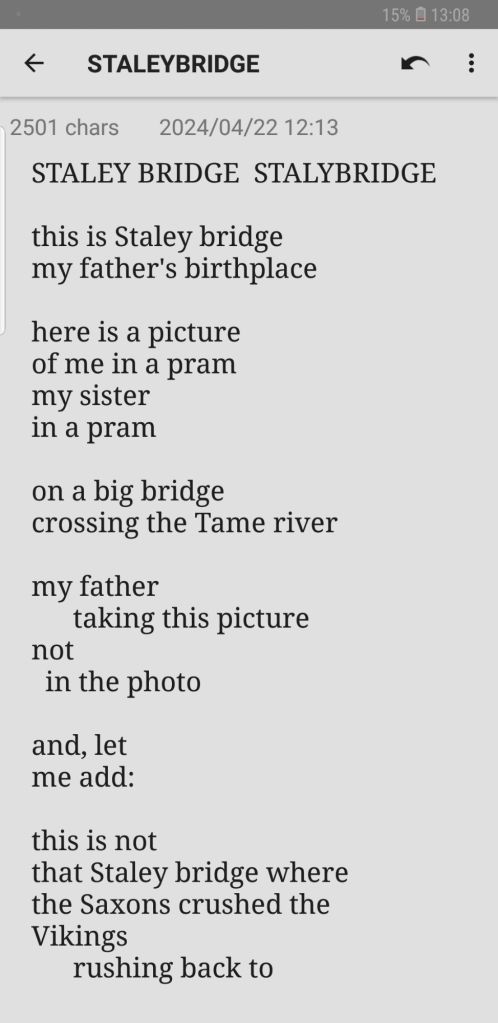
this is Staley bridge
my father’s birthplace
here is a picture
of me in a pram
my sister
in a pram
on a big bridge
crossing the Tame river
this is not
that Staley bridge where
the Saxons crushed the
Vikings
rushing back to
meet my
Norman ancestors at Hastings
and we
know what happened there
****
Yes, here we are
up front Mossley
in that picture, my
Mother
daughter of a war hero
pushing our pram
and there, no doubt,
the great cotton mills
still
doing their job though
not now in
their hey day
postmodernity,
postcoloniality
what landscape altering modes
of production ushered
in in
their wake
and here is Engels incliding
text on this place in his seminal
work on
the working class
in England
and here I am
years later, studying satire living
in his monument house
in Oxford Street Manchester
water
under this bridge, water
connecting
us all
Tipperary, Stalybridge,
Mahikeng South Africa
figures
in a Lowry paintimg
they come
and they go
water
under this bridge then
so much water we
tend to
forget about
water headed
to the port of slavery
same water in the skiffle
psychedelia of those
Sergeant Pepper people
magicians of the airwaves
conjurors of
a whole new
line
in identity
fruit of the clash of
working class proclivities
with
transcendental
mind
clash, I say,
but what a melding, beloved
blending
without which
no way this space, or place,
or room
to talk
gone these guys
or finally fading
gone
those mills of my childhood
Spitfire stories
of how
we stood alone
everything reconfigured,
outright repurposed
voices (and their words)
I fail to recognise, alien
strange
elevated above whilst
so out of frame
somehow talking all
necessities of suppression
commandeering everything
stretching
the distance below
to above
to breaking point
viewed from
the Southern tip of Africa, product
victim of
all that this is metonym of
all this place
this life
of which
I speak
ths
shock
could not be more
extreme
(so dark
these river with
their druid name
we cross
all our lives
each
every day
so quietly all
determining)

 poems 2 die for