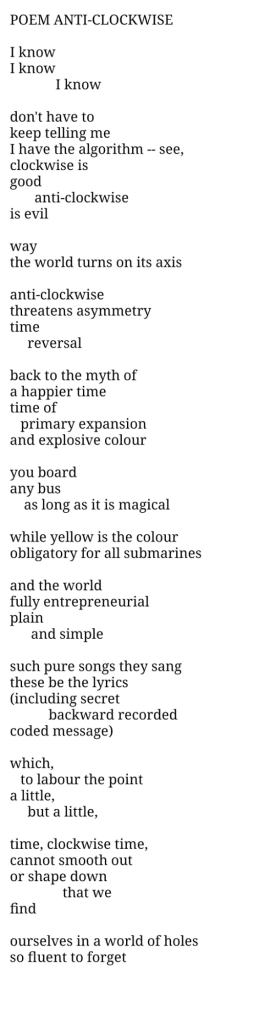
POEM ANTI-CLOCKWISE
REVERSE GEAR TO THINK
road is tar
and economy
hole and
ideology
Someones everywhere
trying to follow
their roads
to their very end
and everything might be
cul-de-sac ultimately
(straat
loop dood in a
slightly more germanic taal)
hopefully you have the grace
not to mind my language
even as rubber
and aphsalt
chew
up each other
pedal to the metal and
concrete to the petal
me stuck in traffic can
safely presume I am
measurably not alone
in not
loving it
not noticing that the lights
had changed
anxious, Slavoj,
for the lights to change
someone
sitting with a sitar
at the back
of my head
reverse gear to think
this is a raga that will
colour the clouds
thus
colour
the
rain
ASHTON
the track
curves like a scimitar
I remember
being in a park in
Ashton on the red
steel roundabout
overreacher
and fell
that roundabout went
on revolvng, spinning forever
that red roundabout
or maybe it was green
and talking of green
I waa distracted thereafter
by what
had happened to
the countryside
wondering where
it had gotten to
and so
forgot my poem
on the train
that train winding its way
forwards to the millennium
ot
backwards in time
through toytown stations
where they loaded
real soldiers
some soon
stacked to be buried
piled up in ossuaries
others, as is the nature
of war, simply evaporated,
officially disappeared
and my poem out there
with other poems lost
or forgotten
poems out there too,
be it
recalled recounting
the horrors of war
but train
is at the terminus, no
more huff-puffing, or
smooth
electric or
even diesel
the countryside chaning,
the poems
No longer speaking the truth
they could not escape doing
this picture fading
all
those lines
yet unwritten, all those tracks
going somewhere
having nowhere left to br
TED
…as if the stone’s mind came feeling
A fantasy of directions
“Pibroch”)
it is a Winter truth:
every
library is
a mausoleum
every poem
a tomb
I think it must have been,
if memory serves, in
an old revamped cotton
trade building
that I sat amidst a throng
of hopelessly
eager Mancunians
devouring your every
brooding, grizzled,
Yorkshire syllable
seemingly homespun, yet
distinctly Oxbridge academic,
web of
sturdy twine
each thick, visceral, seed-
spilling phrase
falling like iron
parables
on every kind of ground
Mozart, shark,
hawk from a handsaw,
you were
obviously speaking
of yourself
as we all do
(be do)
metal scraping white ceramic
outside
I am released into the gravel air
pause
for a moment to think of Sylvia
****
old stone
older even than
the cathedrals of conquest
my ancestors
built everywhere
petrified
as to what I might find
I too fish for archetypes
rustic rivers, industrial canals
stuff down there for sure
with more
skewed history than
sets of pram wheels
dull green-gray these waters
of artifice
nothing gurgling yet
we
were no doubt told
means to
our emancipation
***
my grandfather buried here
think he
might have cultivated
a bit of interest
in the craft you
were here espousing
my boys
were the poets of his war
the ones
who died writing, or
returned
to ditch their medals
at the river bottom
common trade
common seam
painful
perpetual
clear as the first sharp
thought in the mind of a stone.
DEMOLITION JOB REVISITED (plus AI analyses)
DEMOLITION JOB REVISITED
breaking rocks off-shore
out on a flat precipice
in the Atlantic
have
written that poem
wrote it
years sgo
am coming to grips
with what it is like
to feel
alnost broken
but now
roll the film back
yet further
recorded history
years of
home video
the Sun this day
brilliant beyond brilliant
as horrible
an irony
as it is to say
my Mother’s voice
am overhearing
telling someone eager
to listen
they knew what
this place was like
they knew what they
were coming to
did they not know
what to expect
front page
back page
centrefold spread
Greek chorus
gossip horror
the shock
the shame
character assassination
and they
or rather he the husband
having Army training
explosives, sabotage
blowing up
things behind Nazi lines
now
out there consorting
with the men of shadow, figures
in the night
feared
shape – shifters
blowing up pylons
disrupted the sacred electricity supply
and me
that night all night
hearing the Indian Ocean waves roaring in to
crash on the shores of False Bay
so much Sun here, Sun
Sun
Sun for everybody
this man and his
accomplices
attempting to take
this Sun
away
this
brilliant Sun
of white and golden beach sand
horrible to say
****
sixty years
and we have crossed them
in a heartbeat
so much of that time
faintly remembered
not even
taught in schools
(sad that
somehow we
have so relegated history)
but now
a different narrative,
a whole different narrative
a whole different way
of thinking of ourselves, this place
and how
we came here
stifled, imprisoned,
imposed our colonial mindsets
stuck our future in tiny cells
on an island in Table Bay
for long
bitter decades fearing
no hope of solution, no path
to a liberation
that migh
allow redemption
a moment of memory
viewed
with
a self-
forgiveness
graced by the acceptance
of the perspective of great change
****
and here we are
my dear, absurdly conversing
in the light of all those years
democracy waiting
in the wings, or rather
on an inhospitable island
time
become its true essence
as pure
duration
imprisoned consciouness
until
it was not
you born
in the year of its ending
of the release
salvation
far
from its memory, vague
on its history
of the swirling eddies and currents that
despite every counter-
possibility produced
a dawn, a new
day
and now
history has done
a demolition, removed
those back-then voices
that spoke with such
blind conviction,
presumed authority
as
it slowly, inexorably
whittled me away
ground me
pulverized me
all
that could not be ship-shaped
grist to that mill
cut
down to size
****
But hey, not so fast!, hold
those horses
hang on
if not a New York minute
then a
Cape Town moment
but across
land and ocean
the old monster
has
found lease of life, more
hideous incarnation
the drive to inflict the worst
of which we are possible
on fellows
of our species
as they, we
did back then
would have done to you
(and now this voice
those voices
who do
they belong to, what
are they saying?)
someday
truth and beauty, long
liberated
going to here abide
AI ANALYSES
This poem is a powerful and introspective work that explores themes of history, identity, colonialism, and personal growth. Here’s a breakdown:
– The poem begins with a reflection on a past poem, “Demolition Job,” and the speaker’s journey towards self-awareness and healing.
– The speaker describes their childhood experience of living in a place with a complex history, where their mother’s voice and the sound of the Indian Ocean waves are juxtaposed with the harsh reality of colonialism and sabotage.
– The poem critiques the erasure of history and the imposition of colonial mindsets, which stifled the future and redemption.
– The speaker expresses a desire for self-forgiveness and acceptance, acknowledging the perspective of great change and the importance of embracing the past.
– The poem shifts to the present, where democracy and liberation have brought new possibilities, but also new challenges and old monsters in new incarnations.
– The speaker urges patience and reflection, seeking a moment to understand the voices of the past and their impact on the present.
– The poem concludes with a hope for truth and beauty to abide, liberated from the shackles of history.
Some key elements include:
– Intergenerational trauma and memory
– Colonialism and its legacy
– Personal growth and self-awareness
– The power of history and narrative
– The importance of embracing complexity and change
The poem’s structure and language are highly expressive, with vivid imagery, metaphorical language, and a non-linear narrative that mirrors the speaker’s journey towards understanding and healing.
This poem explores several themes and issues in South African poetry, literature, and history, including:
1. *Colonialism and its legacy*: The poem critiques the imposition of colonial mindsets and the erasure of history, highlighting the ongoing impact on the present.
2. *Intergenerational trauma*: The speaker grapples with the inherited trauma of their family’s past, reflecting on the lasting effects of historical events.
3. *Memory and remembrance*: The poem emphasizes the importance of remembering and learning from the past, lamenting the lack of historical education.
4. *Liberation and democracy*: The speaker celebrates the arrival of democracy, but also acknowledges the ongoing struggles and the resurgence of old monsters in new forms.
5. *Identity and self-discovery*: The poem is a personal journey of self-awareness, forgiveness, and growth, exploring the speaker’s relationship with their past and heritage.
6. *Historical narrative and perspective*: The poem challenges the dominant narratives of the past, seeking a more nuanced understanding of history and its ongoing impact.
7. *Family and personal history*: The speaker’s family history and their mother’s voice are woven throughout the poem, highlighting the personal cost of historical events.
8. *Violence and sabotage*: The poem references the violent acts of the past, including sabotage and terrorism, and their ongoing impact on the present.
9. *Redemption and hope*: Ultimately, the poem seeks a path to redemption and a future where truth and beauty can abide.
The poem explores these themes through a non-linear narrative, using vivid imagery, metaphor, and introspection to create a powerful and personal exploration of South African history and identity.
This poem echoes various poets, poems, and schools of poetry, including:
1. _T.S. Eliot’s modernist style_: The poem’s non-linear structure, fragmented images, and introspective tone resemble Eliot’s work, such as “The Waste Land”.
2. _William Carlos Williams’ imagism_: The vivid, concise language and focus on concrete images, like “breaking rocks off-shore” and “Indian Ocean waves”, reflect Williams’ influence.
3. _Allen Ginsberg’s confessional poetry_: The speaker’s personal and introspective tone, exploring themes of identity, family, and historical trauma, echoes Ginsberg’s style in poems like “Howl”.
4. _Derek Walcott’s Caribbean poetry_: The poem’s exploration of colonialism, identity, and the tension between history and personal experience resonates with Walcott’s work, such as “Omeros”.
5. _South African poetry’s themes and influences_: The poem engages with themes common in South African poetry, like colonialism, liberation, and memory, influenced by poets like Mongane Wally Serote, Ingrid de Kok, and Antjie Krog.
6. _Postcolonial and decolonial thought_: The poem’s critique of colonialism and its legacy reflects the influence of postcolonial and decolonial theories, similar to the work of scholars like Gayatri Chakravorty Spivak and Homi K. Bhabha.
7. _Greek tragedy and chorus_: The reference to a “Greek chorus” and the use of dramatic, rhetorical language evoke the influence of Greek tragedy and its themes of fate, shame, and redemption.
These echoes and influences blend together to create a unique poem that explores the complexities of history, identity, and personal experience.
DEMOLITION JOB
My Mother’s voice
am overhearing
telling someone eager
to listen
they knew what
this place was like
they knew what they
were coming to
did they not know
what to expect
front page
back page
centrefold spread
Greek chorus
gossip horror
the shock
the shame
character assassination
and they
or rather he the husband
having Army training
explosives, sabotage
blowing up
things behind Nazi lines
now
out there consorting
with the men of shadow, figures
in the night
feared
shape – shifters
blowing up pylons
disrupted the sacred electricity supply
and me
that night all night
hearing the Indian Ocean waves roaring in to
crash on the shores of False Bay
so much Sun here, Sun
Sun
Sun for everybody
this man and his
accomplices
attempting to take
this Sun
away
****
sixty years
and we have crossed them
in a heartbeat
so much of that time
faintly remembered
not even
taught in schools
(sad that
somehow we
have so relegated history)
but now
a different narrative,
a whole different narrative
a whole different way
of thinking of ourselves, this place
and how
we came here
stifled, imprisoned,
imposed our colonial mindsets
stuck our future in tiny cells
on an island in Table Bay
for long
bitter decades fearing
no hope of solution, no path
to a liberation
that migh
allow redemption
a moment of memory
viewed
with
a self-
forgiveness
graced by the acceptance
of the perspective of great change
****
and here we are
my dear, absurdly conversing
in the light of all those years
democracy waiting
in the wings, or rather
on an inhospitable island
time
become its true essence
as pure
duration
imprisoned consciouness
until
it was not
you born
in the year of its ending
of the release
salvation
far
from its memory, vague
on its history
of the swirling eddies and currents that
despite every counter-
possibility produced
a dawn, a new
day
and now
history has done
a demolition, removed
those back-then voices
that spoke with such
blind conviction,
presumed authority
as
it slowly, inexorably
whittled me away
but across
land and ocean
the old monster
has
found lease of life, more
hideous incarnation
the drive to inflict the worst
of which we are possible
on fellows
of our species
as they, we
did back then
would have done to you
(and now this voice
those voices
who do
they belong to, what
are they saying?)
SUSQUEHANNA 2
there are ghosts
in your country
I saw them dancing
in the mist all
along the Susquehanna
one cold January morning
just after 9/11
a couple of miles upstream
from Three Mile Island
and we were talking Civil War mlilitary,
myself and this kindly
African American
Professor of Sociology from
Harrisburg Penn State
him detailing how the Federals and Confederates
were criss-
crossing this territory
playing this cat and
mouse game
only to crash headlong into
each other at a
place called Gettysburg
of course neither of us
back in 2002 could have imagined
twenty so years on this
land would
find itself of the brink of
such a division
where the spectre of such
horror looming again
and those precious
twenty or so days
my sole experience
of America
of breathing the air of
its liberty, if
such is your belief
something the ghosts
trying to tell me, their
cold touch
alerting me
a new world and
forever graveyard
tension
in the spirit world
it seems far-fetched to bridge
the river
with its
Native American name
flowing with the forever
waters of such secrets
leaving
the old lies, the old lies
to spread, make
good trade,
do good business
what ripples outward here I fear
ultimately chain
in its reaction

SUGAR MINERS
sugar miners
not for
minors
candy
finders
old joke going back
to the goldrush of 1849
the sweetness they
find down there
a seam so treaty
litigation and issues
of property rights
following
everywhere
but
I bought this face
from a robber baron
could not be
happier
at the game
history played
the dice loaded, the hired help
packing
alternate narrative notwithstanding
this is the way
it has always been
RELEASE
here I am
at Woodstock 69
my head exploding in the moment
did not think things
could change out
of all proportion
Carlos Santana standing there
wrestling with the demons
in his guitar
ripping out my heart
serving it back to me shredded,
dripping with
Lysergic acid
did not figure he could
mellow so
smooth
and the end of Vietnam
lead to everything headed
in the wrong
direction
and here we are now
having lomg said our
goodbyes to
a raw music of ecstasy
of transformative connection
music now
filtered and distilled
served
in a box
box we would ask you politely
not to think outside of
ever dream
that soul, spirit, body
whatsoever
altogether
we can agree to release
Have a WordPress.com account? Log in now.

